E-mail: [email protected]
E-mail: [email protected]Address: NO. 132 Xingye Road,Fengqiao Town ,Zhuji City,Zhejiang
Whatsapp: +86-13958007768
Whatsapp: +86-13655857582




Need Help
+86-13958007768
E-mail: [email protected]
E-mail: [email protected]
Address: NO. 132 Xingye Road,Fengqiao Town ,Zhuji City,Zhejiang
Whatsapp: +86-13958007768
Whatsapp: +86-13655857582
Our team is proud to offer on time guarantee and product guarantee to customer satisfaction.
Read MoreNews
 Home / News / Industry News / ECAS Valve vs Mechanical Leveling Valve: Which Suspension Control Wins
  2026.07.02
 Industry News
An ECAS (Electronically Controlled Air Suspension) valve outperforms a mechanical leveling valve on every multi-axle commercial vehicle where response speed, diagnostics, and load-transfer control matter.
A mechanical leveling valve still holds its place on simple single-axle trailers where lower cost and mechanical simplicity outweigh the precision an electronic system offers.
Underneath a loaded semi-trailer or transit bus, the suspension is only as good as whatever is deciding how much air goes into each bag at any given moment. That decision either happens through a mechanical linkage slowly adjusting airflow as the chassis moves, or through a solenoid valve reacting to an electronic control unit within milliseconds. The gap between those two approaches shows up clearly once you compare them on the metrics that actually matter for fleet operators: response time, precision, and how much the system tells you when something goes wrong.
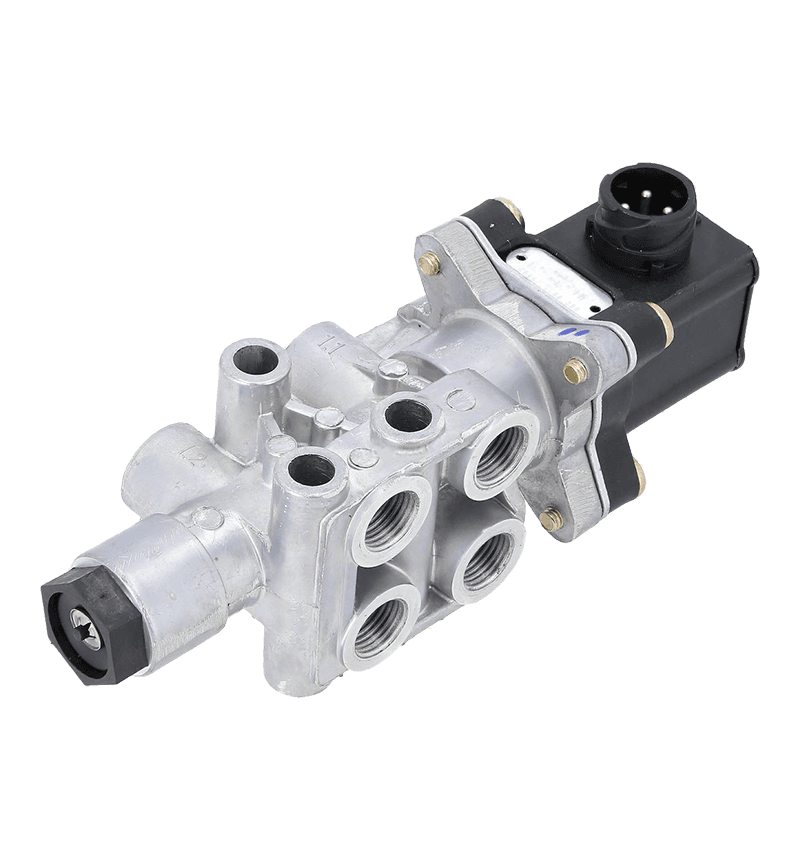
A mechanical leveling valve uses a physical linkage connected to the axle — as the chassis rises or falls relative to the axle, the linkage rotates a spool inside the valve that gradually opens or closes an air passage. An ECAS valve replaces that mechanical linkage with a height sensor feeding data to an electronic control unit, which then commands a solenoid to open fully or close fully based on calculated need.
That "full open or full closed" behavior is a defining trait of solenoid valves — unlike a mechanical spool valve that throttles air gradually as it moves, a solenoid valve is a binary switch, which sounds less refined but actually gets the suspension to target height faster because the full air passage is available immediately rather than opening incrementally.
The practical difference between the two valve types shows up most clearly during loading and unloading, when chassis height needs to adjust quickly and repeatedly as weight shifts. A mechanical valve throttles air in gradually, meaning it takes measurably longer to reach the correct bag pressure after each load change. An ECAS valve's electronic control lets it open completely for maximum airflow, then close the instant the ECU calculates target height has been reached.
Not every ECAS installation controls the suspension the same way. Single-point configurations use one valve and one height sensor to manage an axle group as a unit, while multi-point configurations use separate sensors and solenoid valves for each side or each axle, allowing independent correction.
| Configuration | Control Precision | Best Fit |
| Single-point ECAS | Whole axle group treated as one unit | Simpler trailers, cost-sensitive fleets |
| Multi-point ECAS (per-side) | Left/right independent correction | Uneven loading, off-camber road use |
| Multi-axle ECAS (per-axle) | Full independent axle control | Multi-axle trucks, buses, load-transfer needs |
| Mechanical leveling valve | Fixed per-axle, no cross-referencing | Single-axle trailers only |
Multi-point configurations are also what makes load transfer possible on tandem or tridem axle trucks — shifting weight from a tag axle to a drive axle to improve traction requires independently controlling pressure across specific axles, something a simple mechanical valve setup has no way to coordinate.
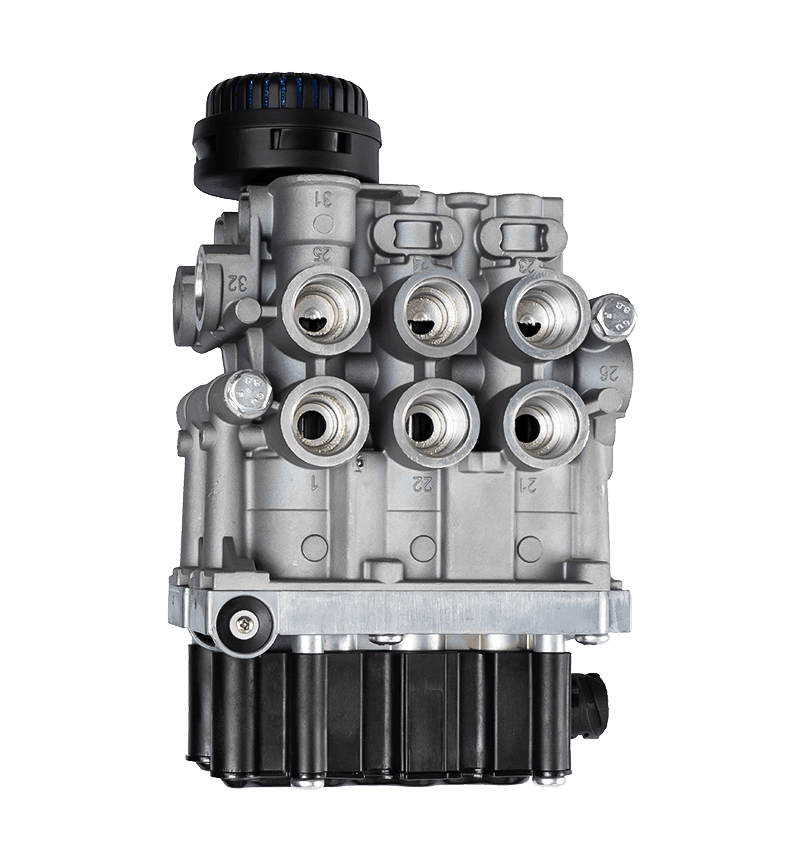
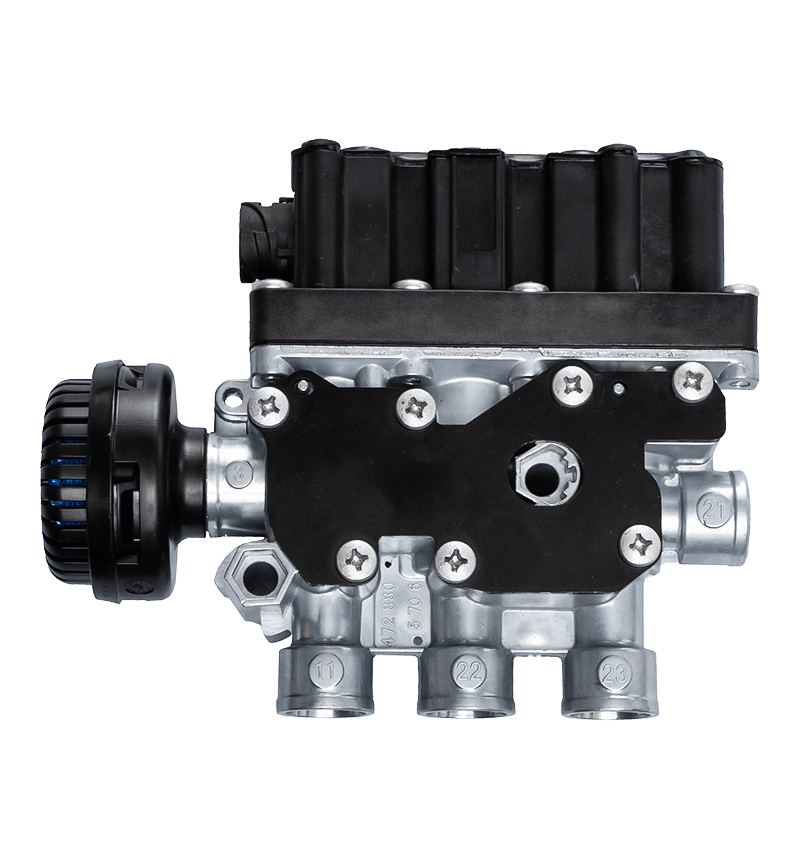
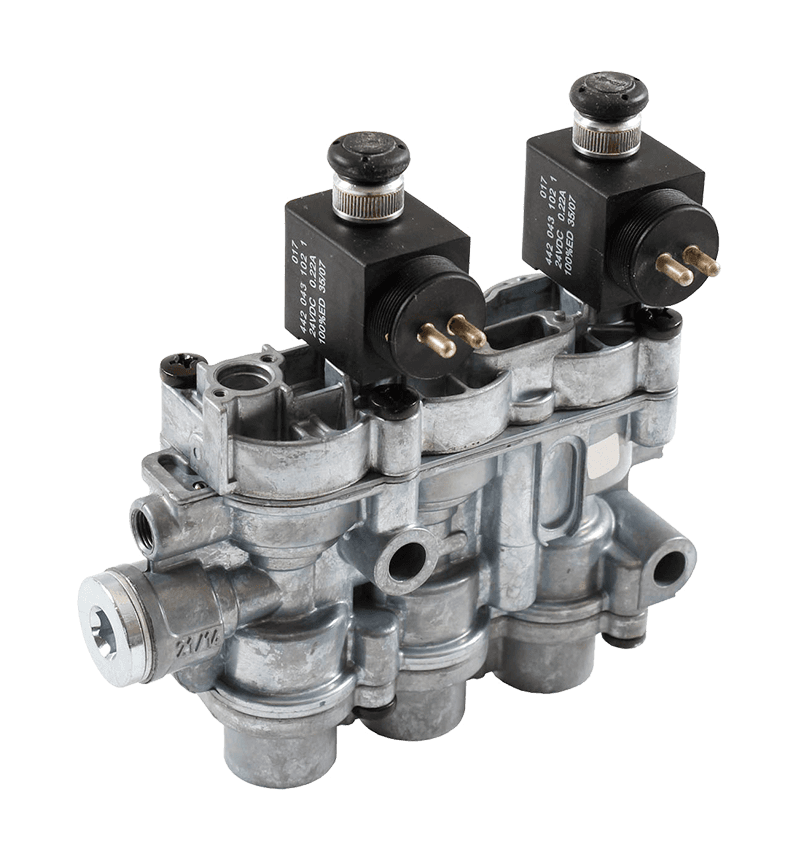
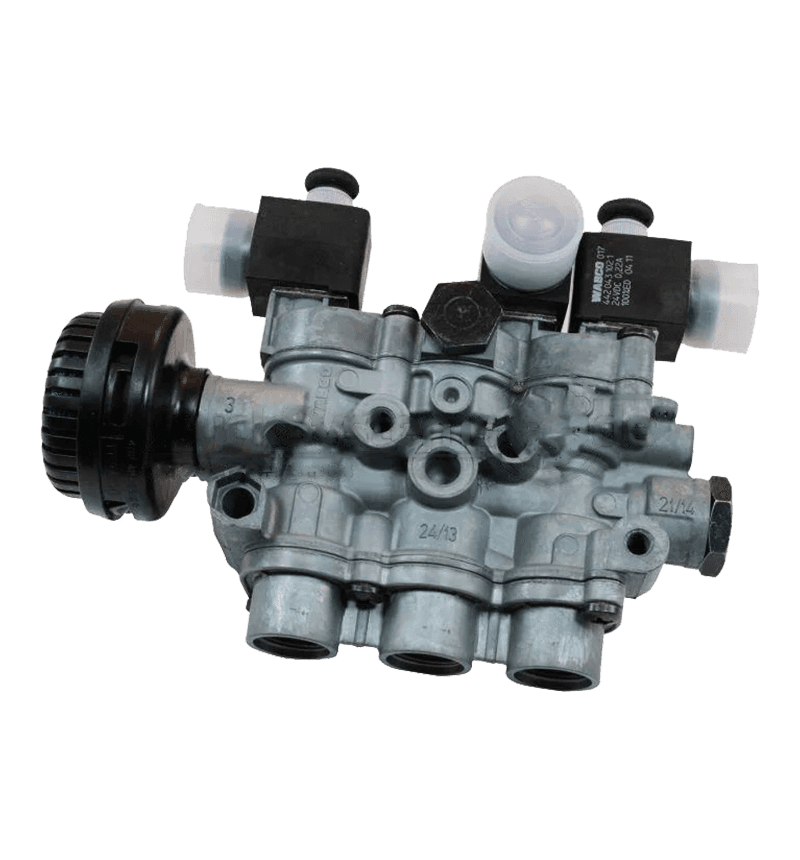
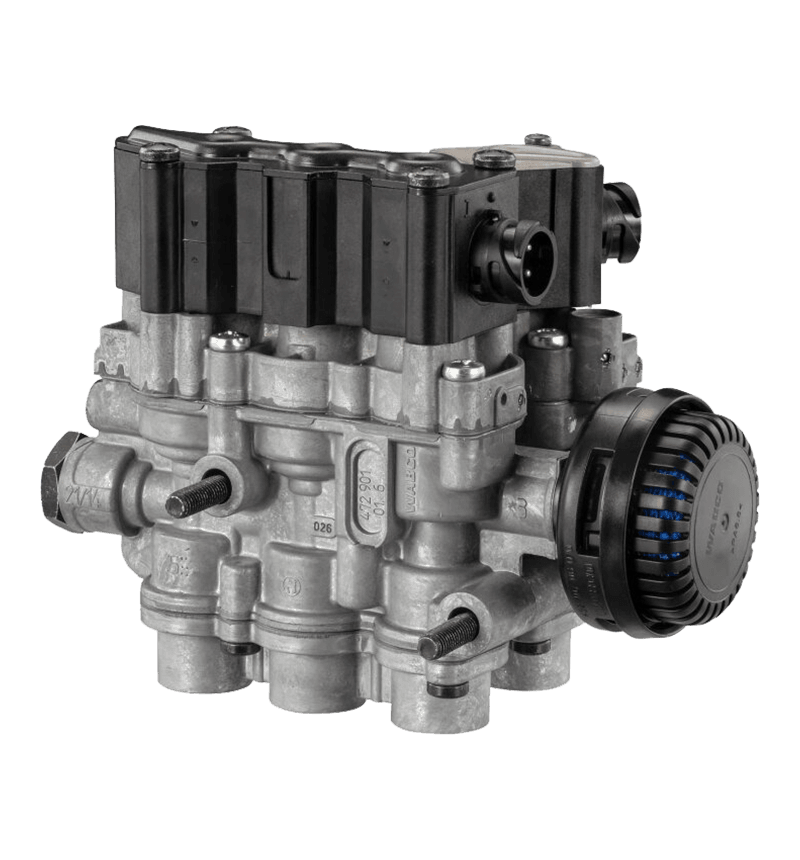
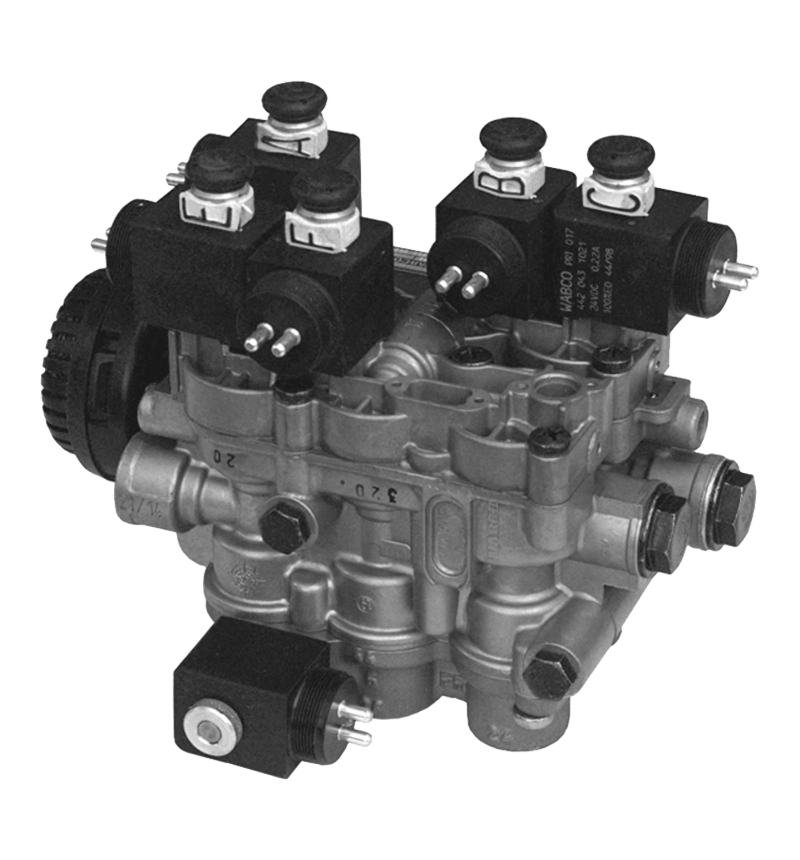
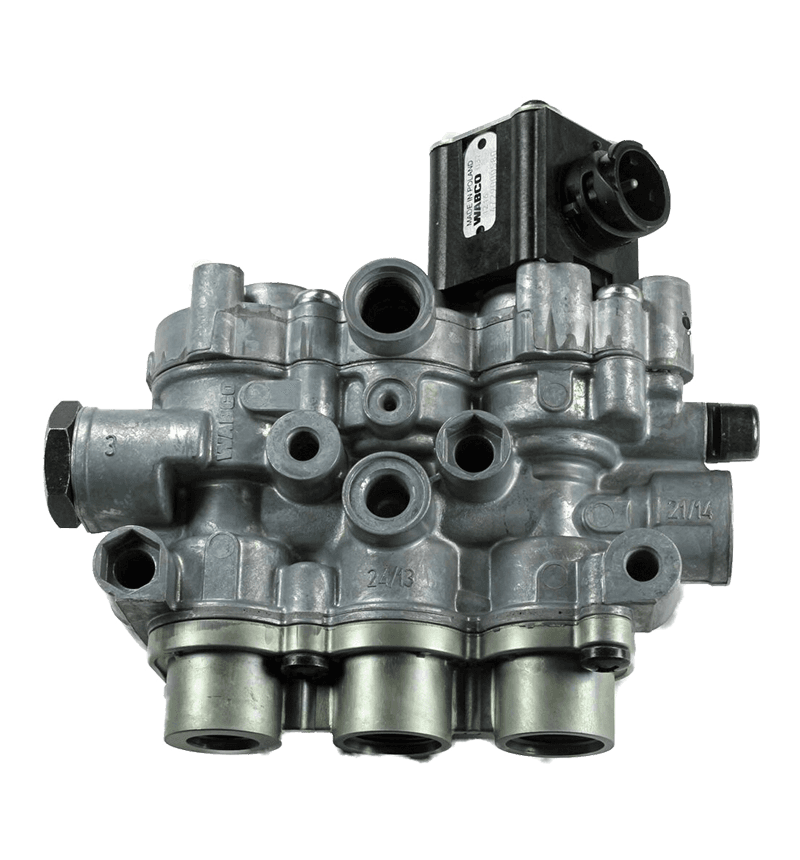
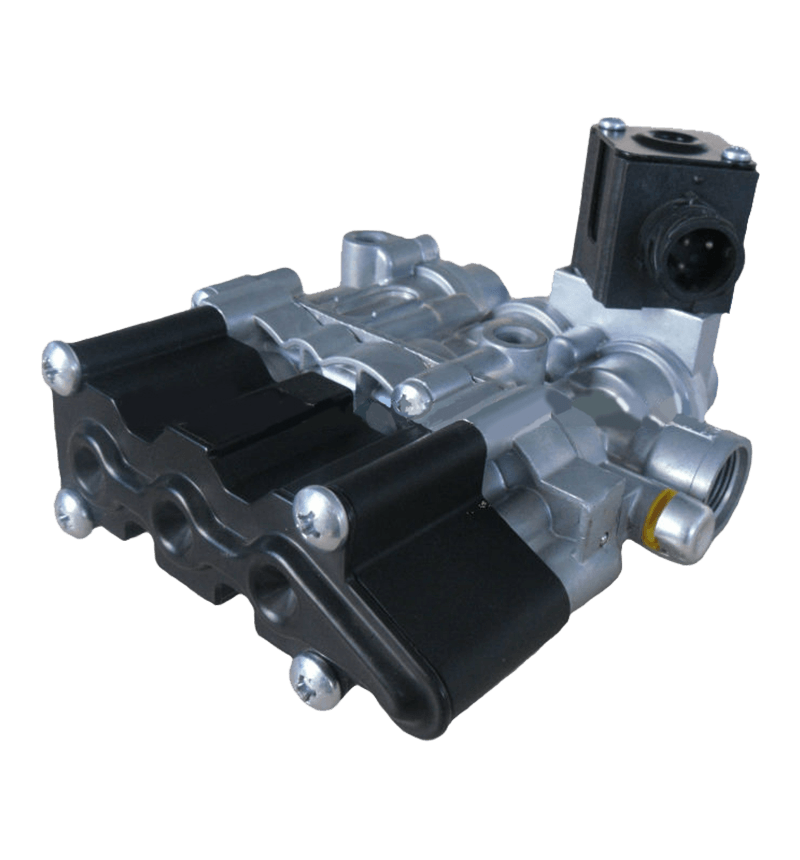
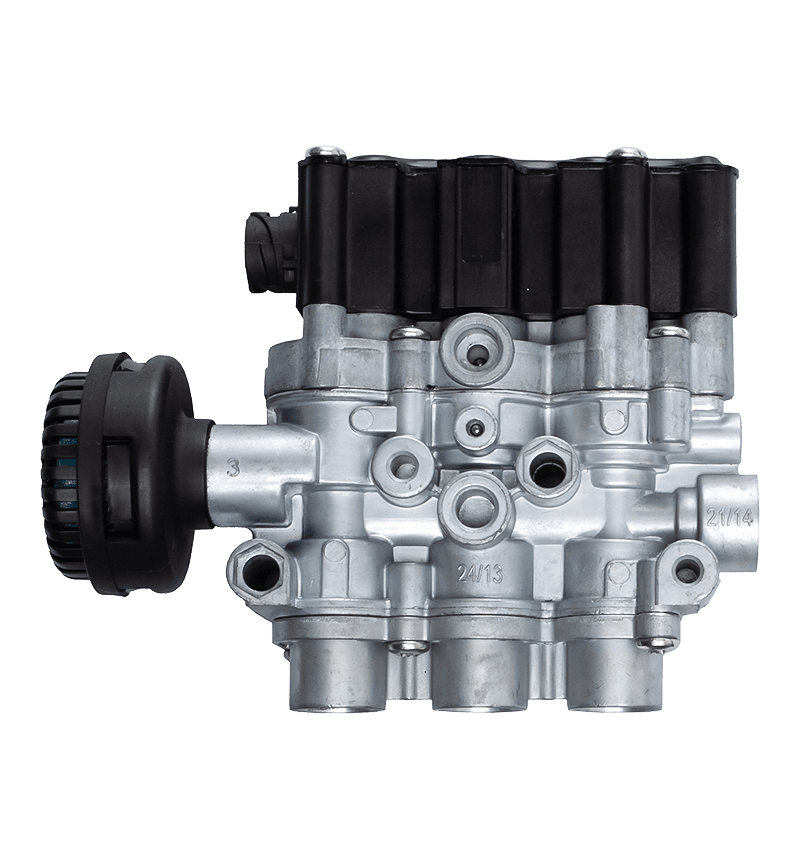
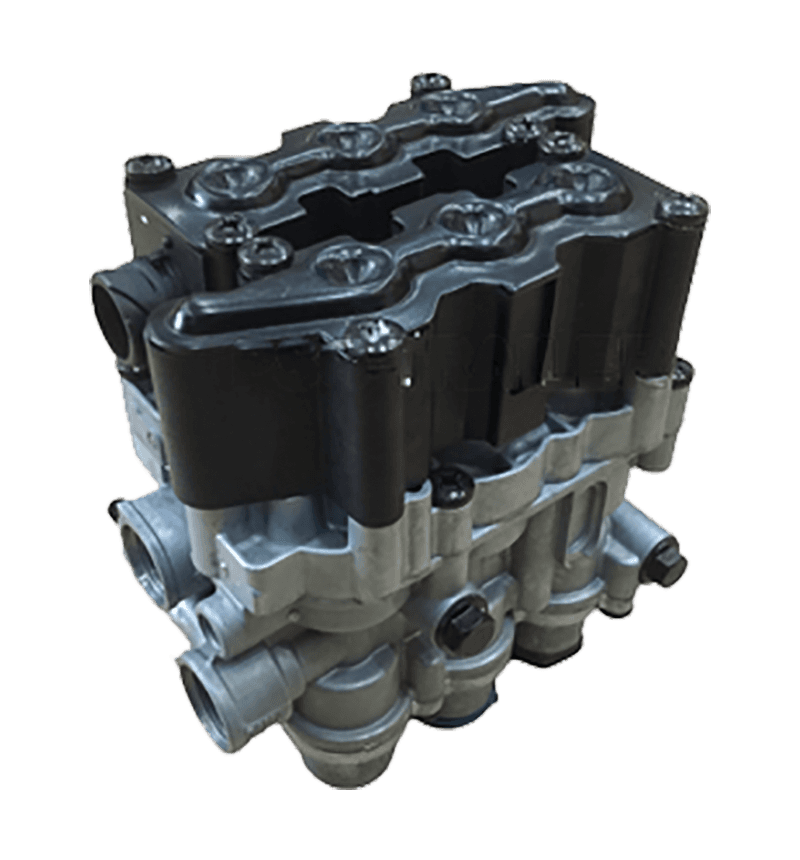
Manufacturers building ECAS systems generally combine several solenoid valves into a single compact valve block rather than mounting individual valves separately across the chassis, and this consolidation has real service implications worth comparing.
Fewer connection points and simpler wiring harness, faster installation, and a more compact footprint — but a fault often means replacing or servicing the entire block rather than a single valve.
Individual valves can sometimes be serviced or replaced independently, but the wiring and plumbing complexity across the chassis increases, along with more potential failure points at each individual connection.
In practice, most heavy-duty ECAS systems on trucks and buses use integrated valve blocks specifically because the reduced wiring complexity outweighs the downside of block-level replacement — a well-designed block also simplifies diagnostics since all the solenoids share common test points.
This is where the gap between the two systems is widest. A mechanical leveling valve gives no electronic feedback at all — a technician has to physically inspect linkage, check for air leaks, and manually verify valve movement to diagnose a problem. An ECAS system continuously monitors its own components and reports faults through a dash-mounted indicator lamp and stored diagnostic codes readable through dedicated diagnostic software.
Diagnostic capability also extends to functional testing: technicians can activate individual ECAS valves one at a time through diagnostic software to confirm each solenoid opens and closes correctly, isolating a faulty valve within a block far faster than manually testing a mechanical linkage system component by component.
Mechanical leveling valves fail primarily through linkage wear, corrosion at the pivot points, or internal spool wear from years of gradual throttling. ECAS solenoid valves fail differently — coil resistance drift, connector corrosion, or debris lodging in the valve seat are the most common issues, and because the valve is either fully open or fully closed, a partially stuck valve tends to produce more obvious symptoms (a stuck-high or stuck-low corner) rather than a gradual performance decline.
 NO. 132 Xingye Road,Fengqiao Town ,Zhuji City,Zhejiang
 +86-13958007768 +86-13655857582
Copyright © Zhuji Infia Auto Parts Co., Ltd. All Rights Reserved.
Wholesale Truck/Bus Brake Parts Suppliers
 English
 Español