E-mail: [email protected]
E-mail: [email protected]Address: NO. 132 Xingye Road,Fengqiao Town ,Zhuji City,Zhejiang
Whatsapp: +86-13958007768
Whatsapp: +86-13655857582




Need Help
+86-13958007768
E-mail: [email protected]
E-mail: [email protected]
Address: NO. 132 Xingye Road,Fengqiao Town ,Zhuji City,Zhejiang
Whatsapp: +86-13958007768
Whatsapp: +86-13655857582
Our team is proud to offer on time guarantee and product guarantee to customer satisfaction.
Read MoreNews
 Home / News / Industry News / Bus Brake Parts: A Fleet Buyer's Guide to Air Brake Valves, Dryers and Components
 2026.10.15
 Industry News
A bus that refuses to release its parking brake at the depot gate rarely has a chamber problem. The fault usually sits in the hand brake valve, in a relay valve that has stopped responding, or in moisture that has been circulating through the air system for months. That pattern shapes the way fleet buyers should approach bus brake parts: the large, visible components get replaced on schedule, while the small valves that decide when and how hard the brakes apply are ignored until a vehicle is out of service.
The practical answer is to buy by circuit rather than by price list. Split the system into air supply, control and actuation, work out which circuit produced the fault, and order only then. The sections below cover what sits in each circuit, the pressure figures worth writing into a purchase order, and the details that separate a part that fits from one that merely looks right.
A city bus and a long-haul truck share the same air brake architecture, but they do not share the same duty cycle. A bus can make several hundred brake applications in a single shift, its doors and suspension draw air from the same supply, and its parking brake is cycled at every stop. Valves that last years on a highway truck wear faster under that rhythm.
Bus brake parts fall into three connected groups:
The diagram below shows how those groups interact on a typical bus.
Because every circuit draws from the same supply, a saturated air dryer can present itself as a brake fault. Moisture carried into a relay valve freezes in cold weather, the valve stops delivering, and the driver reports a pedal that feels normal while the rear axle does very little. The relay valve is then replaced, while the desiccant that caused the failure stays in service and does the same thing again next winter.
For a wider breakdown of valve families, see common classifications of vehicle brake valves.
Four components account for a large share of bus brake part orders, and each one has a specification that decides whether the replacement behaves like the original.
Foot brake valve. This is the driver's input, normally a dual-circuit treadle valve that delivers pressure in proportion to pedal travel. Two details decide fit: which port feeds which axle, and the treadle geometry. A valve with a different pedal ratio can pass a bench pressure test and still feel wrong under a driver's foot, because the force needed to reach a given pressure has changed.
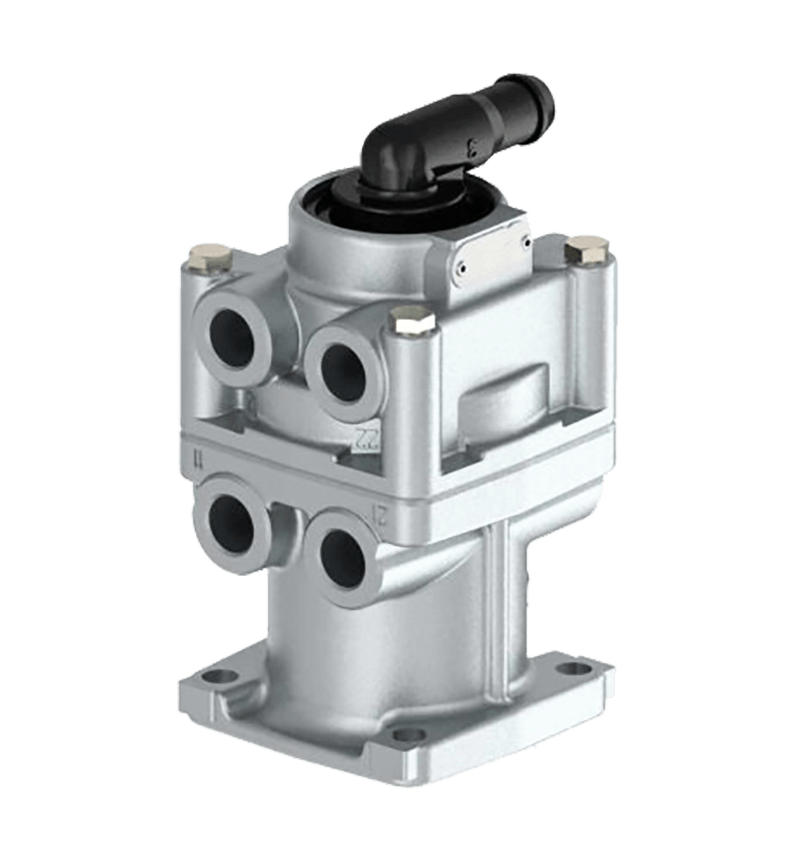 Foot Brake Valves and Treadle Valves for Trucks and BusesBrowse foot brake valves and treadle valves with YFY models, varied port threads, OEM references, and fitment for major commercial vehicle makes.View Product →
Relay valve. Mounted near the axle, it takes a low-pressure signal from the foot valve and delivers reservoir pressure straight to the chambers, which shortens the gap between the foot moving and the brakes applying. Cracking pressure and delivery rate matter more than the housing. A relay valve that opens at a slightly higher signal pressure delays rear application by a fraction of a second, and that is enough to change how a bus behaves on a wet descent.
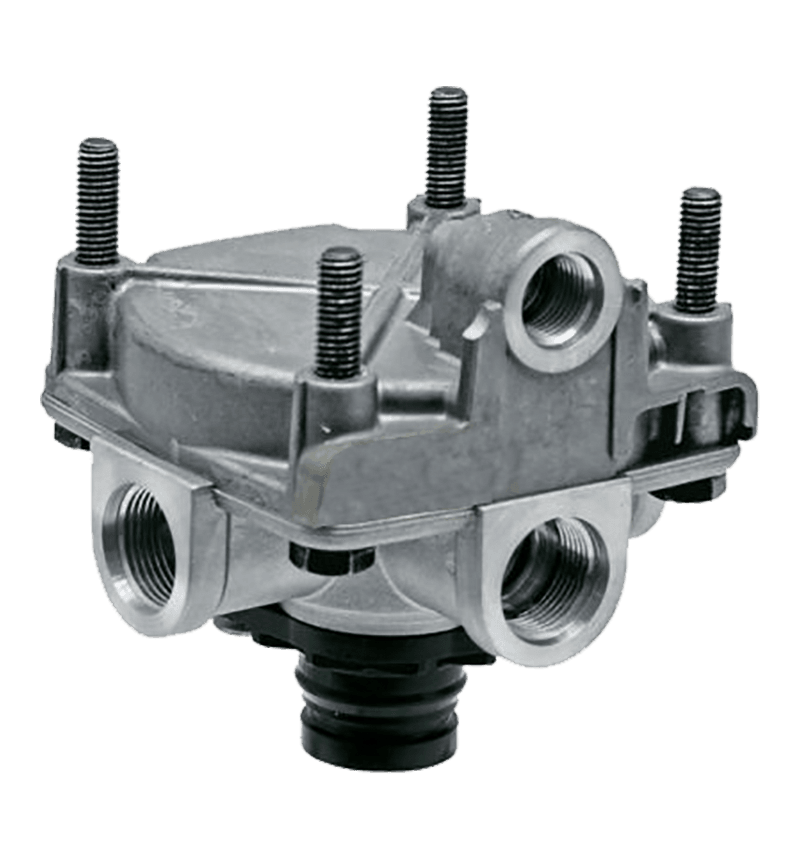 Relay Valves for Truck and Trailer Brake SystemsBrowse relay valves, including trailer and spring brake control types, with OE references, multiple port threads, and fitment for major commercial vehicle makes.View Product →
Quick release valve. It exhausts chamber pressure at the valve instead of sending it back through the foot valve, so the brakes release as soon as the pedal lifts. On stop-start bus routes, a partly blocked exhaust port leaves the brakes dragging, which raises drum temperature and shortens lining life.
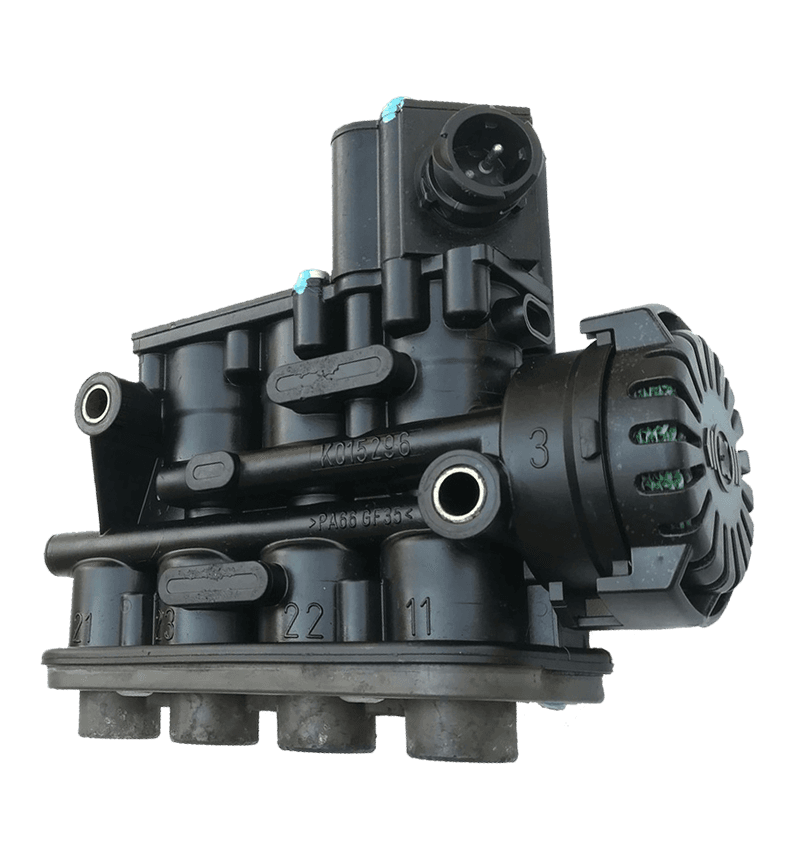
Air dryer. Everything downstream depends on it. Desiccant volume, purge valve setting and, on buses in cold climates, the heater element all need to match the chassis. A cartridge with less desiccant than the original saturates earlier, and the first symptom is usually not water in the tanks but a valve that sticks.
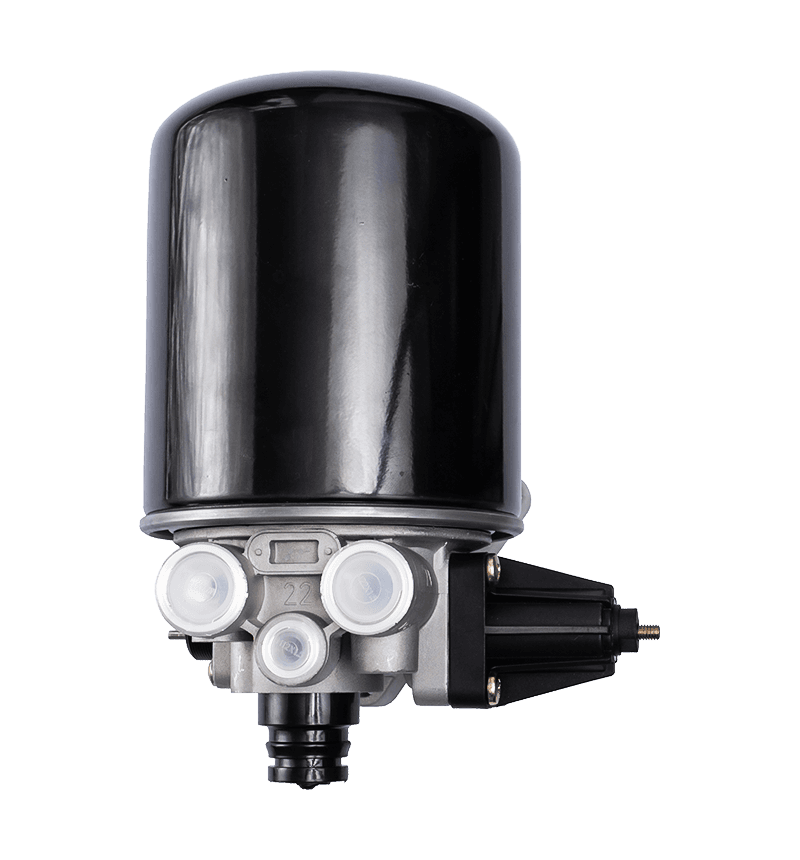 Air Dryers and Dryer Valves for Commercial Vehicle BrakesBrowse air dryers and dryer valves with YFY models, OEM references, varied ports and pressures, plus fitment for trucks, buses, and American vehicles.View Product →
Two more parts belong on a fleet shelf: the hand brake valve, where lever detents and the exhaust port decide whether the parking brake releases cleanly, and the spring brake chamber, where stroke type, pushrod length and port thread are the usual sources of a mismatch.
A replacement valve with the correct thread and the wrong spring changes the balance between circuits. The chart below shows the pressure points that come up most often when a bus air brake system is tested in the workshop.
These are working ranges for a conventional air brake system, not a universal specification. The workshop manual for the chassis always takes priority, and buses with electronic braking or an air suspension controller may use different thresholds.
When a valve comes back to the bench, three checks settle most arguments about quality: does it hold rated pressure with no audible leak, does it return to the exhaust position without sticking, and does delivery pressure track the signal smoothly instead of jumping at one point? A part tested only for "it fits and it holds" will pass a quick inspection and still come back.
Bus platforms differ far more than the catalogues suggest. The table below lists the checks that catch most mismatches before the vehicle returns to service.
| Component | Common complaint | Check before ordering |
|---|---|---|
| Foot brake valve | Slow release, uneven circuit pressure | Circuit split, treadle ratio, port threads |
| Relay valve | Rear brakes apply late | Cracking pressure, delivery rate, bolt pattern |
| Quick release valve | Brakes drag after release | Exhaust port condition, flow rating, port size |
| Air dryer | Moisture in reservoirs, valve sticking | Desiccant volume, heater voltage, cartridge number |
| Hand brake valve | Parking brake will not release | Lever detents, exhaust port, connection size |
| Spring brake chamber | Slow release, uneven parking brake | Stroke type, pushrod length, port thread |
Most of the cost of a wrong brake part is not the part. It is the bay it occupies, the road call it causes and the second repair it creates.
M22 x 1.5, M16 x 1.5 and 1/4 NPT all appear across bus platforms, sometimes on the same vehicle. A thread that almost fits will cross-thread, and a crossed port in a cast valve body cannot be repaired. Check bolt spacing as well: two valves can share a port layout and still not bolt to the same bracket.
Seal compound matters more on a bus than on a truck because of cycle count. Nitrile suits standard air systems, but where oil carry-over from the compressor is heavy or temperatures swing widely, confirm the compound and its rated range with the supplier instead of assuming. A valve rated from minus 40 to plus 80 degrees Celsius covers most operating conditions, and that range should appear on the data sheet.
Springs and seals are where low-cost parts fail first, and they often fail in batches: if one valve from a shipment sticks, treat the rest as suspect until the batch is checked. Where a bus model is old or a valve is no longer stocked, the practical route is to supply a drawing or a sample and have the part made to it. Zhuji Infia Auto Parts has built valves for vehicle brake systems since 2007 and develops parts from customer drawings and samples, which is often faster than chasing obsolete stock.
Bus brake parts are not a catalogue problem, they are a system problem. Air supply, control and actuation have to be matched to one another, and a valve that meets the drawing but not the duty cycle will be back in the workshop within a season.
Start with the fault the driver described, test the circuit with a gauge instead of replacing parts by guesswork, and specify the pressure behaviour you need rather than the part number alone. Fleets that work in that order replace fewer valves, spend less time on road calls and get more consistent brake feel across the whole bus.
 NO. 132 Xingye Road,Fengqiao Town ,Zhuji City,Zhejiang
 +86-13958007768 +86-13655857582
Copyright © Zhuji Infia Auto Parts Co., Ltd. All Rights Reserved.
Wholesale Truck/Bus Brake Parts Suppliers
 English
 Español