E-mail: [email protected]
E-mail: [email protected]Address: NO. 132 Xingye Road,Fengqiao Town ,Zhuji City,Zhejiang
Whatsapp: +86-13958007768
Whatsapp: +86-13655857582




Need Help
+86-13958007768
E-mail: [email protected]
E-mail: [email protected]
Address: NO. 132 Xingye Road,Fengqiao Town ,Zhuji City,Zhejiang
Whatsapp: +86-13958007768
Whatsapp: +86-13655857582
Our team is proud to offer on time guarantee and product guarantee to customer satisfaction.
Read MoreNews
 Home / News / Industry News / Hand Brake Valve: How It Works, Failure Warning Signs, and Buying Tips
  2026.10.01
 Industry News
A driver pulls the yellow knob on the dashboard, hears a sharp exhaust of air, and steps out without worrying that the truck will roll. That simple action depends on a hand brake valve, a component many fleets only think about after it starts leaking or sticking. As a manufacturer of commercial vehicle brake valves, we hear the same questions from buyers again and again: How does this valve actually work, and what does a failing one feel like?
Here is the direct answer: the hand brake valve is the control element that applies and releases the parking brake on a truck or bus by sending or exhausting compressed air to and from the spring brake chambers. Its condition directly determines whether a vehicle stays parked, stops on a grade, or moves safely into traffic.
The hand brake valve, also called a parking brake valve or dash control valve, is mounted in the cab and operated by the driver. It is a pneumatic control valve, which means it does not create braking force by itself. It directs compressed air into or out of the spring brake chambers on the rear axles.
When the driver pulls the valve knob out, the valve exhausts air from the spring brake chambers. The powerful springs inside the chambers extend and mechanically lock the wheels. When the driver pushes the knob in, the valve supplies air to the chambers, compressing the springs and releasing the brakes. This design carries a built-in safety feature: if the air system loses pressure, the springs apply the brakes automatically and keep the vehicle stationary.
Because the valve controls a safety-critical function, its internal construction matters. Most hand brake valves use a poppet-and-seat arrangement with a cam or plunger that actuates the poppet as the handle moves. The valve must seal completely when closed, exhaust quickly when opened, and give the driver a clear feel that the brake has been applied or released.
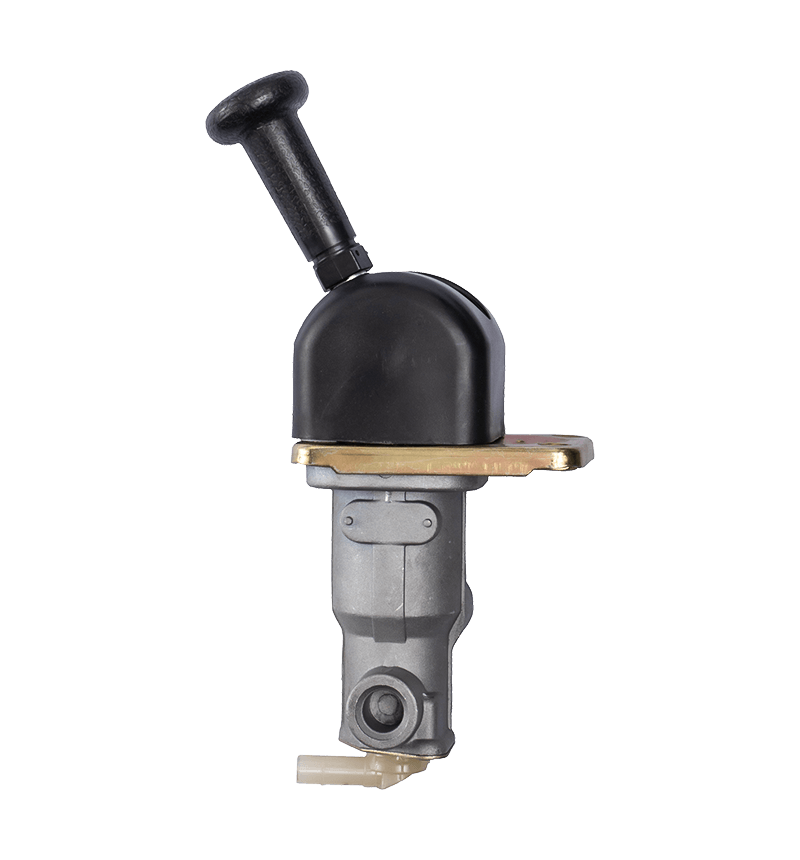 Hand Brake Valves for Truck Parking Brake SystemsThis hand brake valve listing covers port configurations for major truck brands and explains the two-position versus three-position choice, helping buyers select the right valve for reliable parking brake control.View Product →
Buyers also need to distinguish the two main variants. A two-position valve simply applies or releases the parking brake and is the standard for most linehaul and construction vehicles. A three-position version adds a modulated position, mainly for hilly terrain and incline starts. For most applications, the two-position valve is the more reliable and economical choice.
To understand failures, follow the air path. The hand brake valve sits between the vehicle air supply and the spring brake chambers. In a parked condition, the valve is pulled out, the delivery line is open to atmosphere, and the chambers stay vented. When the driver pushes the valve in, supply air flows through the valve into the chambers, pushes the spring back, and releases the brake.
The exhaust port is one of the most stress-loaded parts of the system. Every time the driver applies the parking brake, the valve must vent the full volume of the air lines plus the chambers. A restricted exhaust port or a worn seal slows this process, so the parking brake takes several seconds to engage. That delayed response becomes critical during an emergency stop or on a steep grade.
Leakage in the opposite direction is even more dangerous. If the valve leaks supply air past its internal seat while in the applied position, pressure slowly builds in the spring chambers, and the parking brake gradually releases. The vehicle can begin to roll without any warning lamp. This is why the hand brake valve and the spring brake chambers are always treated as one circuit. Our spring brake chamber range covers the same operating pressures and port configurations, so replacement planning should treat the pair as a matched set.
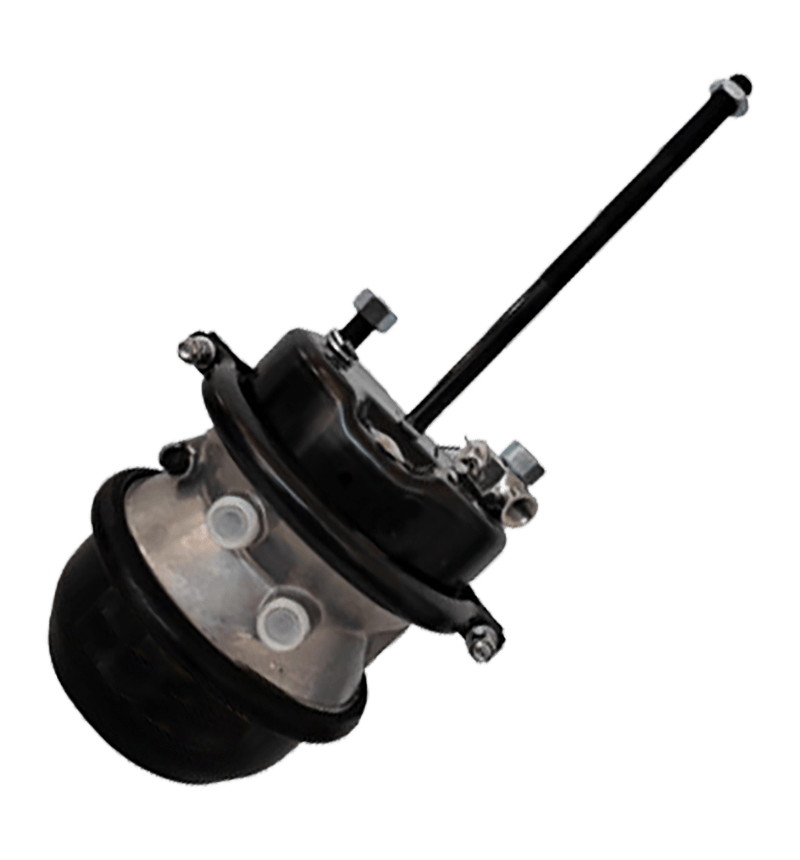 Spring Brake Chambers Matched to Hand Brake ValvesThese spring brake chambers share the same operating pressures and port threads as the hand brake valve circuit, making them a practical replacement pair for maintaining a safe parking brake system.View Product →
The hand brake valve does not work alone. It shares the air supply with the foot brake valve, relay valves, quick release valves, and the trailer control valve. The key relationship is this: the service brake circuit controls the wheels through the foot brake valve, while the parking brake circuit controls the same wheels through the hand brake valve and spring brake chambers. The two circuits must not interfere with each other.
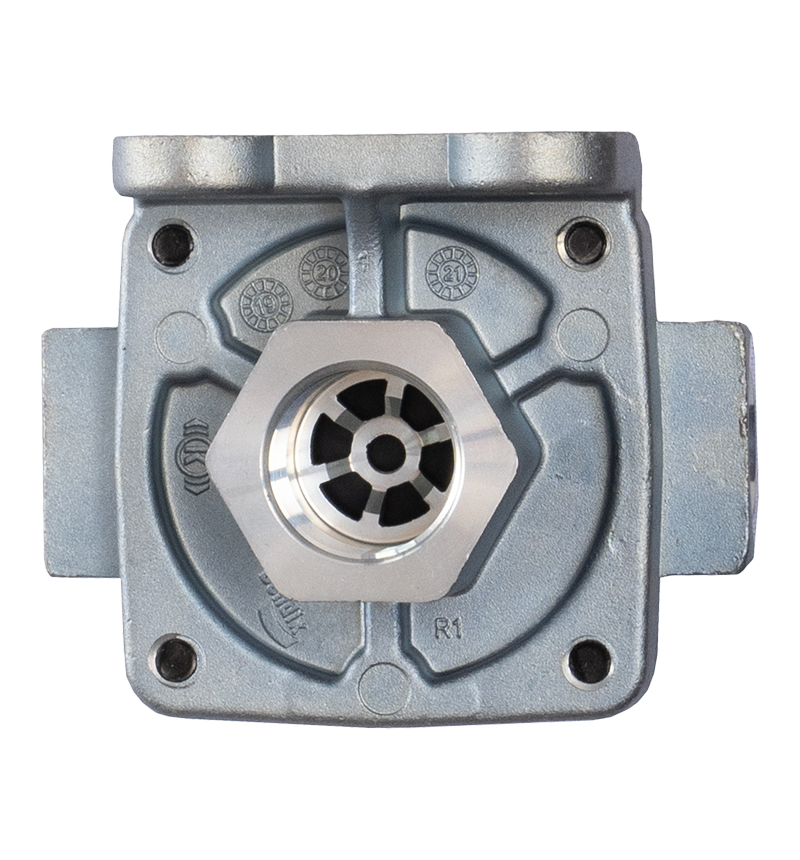 Quick Release Valves Compatible with Multiple Truck BrandsThis quick release valve range supports WABCO-style fitment across popular commercial vehicles, with fast exhaust response to prevent brake drag and avoid misdiagnosed ABS issues in fleet operations.View Product →
On vehicles equipped with ABS, the hand brake valve remains independent of the ABS modulation cycles. The ABS system only controls service brake pressure during an active intervention. However, the hand brake valve must release fully before ABS can do its job, because any residual pressure in the spring chambers drags the brakes and confuses the wheel speed sensors. In practice, a dragging parking brake is frequently misdiagnosed as an ABS fault. Understanding how the hand brake valve and the ABS system work together can save a fleet hours of diagnostic time.
A hand brake valve rarely fails without warning. The problem is that the warnings are easy to miss in a busy workshop. These patterns show up most often, with the fastest way to confirm each one:
| Symptom | Likely cause | Fastest check |
|---|---|---|
| Parking brake will not hold on a slope | Wear or contamination on the poppet seat allows supply air to leak into the delivery line | Apply the parking brake, listen for hissing, and watch the gauge |
| Brake engages slowly after pulling the knob | Restricted exhaust port, blocked silencer, or collapsed delivery line | Pull the valve out and time the pressure drop |
| Brake drags or releases slowly | Worn supply-side seal or insufficient air flow through the valve | Push the valve in and confirm full pressure reaches the chambers |
| Continuous audible leak near the dash | Damaged O-ring, loose fitting, or cracked valve body | Apply soapy water to the valve body and connections |
The soapy water test is the first line of defense and catches most external leaks in minutes. For internal leakage, a shop air gauge connected to the delivery line is more reliable: pull the valve out, note the pressure, and wait. A healthy valve holds steady. A valve with internal leakage shows a slow rise in delivery pressure, which is exactly the condition that leads to an unexpected roll-away.
If you need a step-by-step method before removing the valve from the vehicle, our guide on how to determine whether hand brake valves are leaking covers the procedure in detail, including the pressure readings to expect on standard commercial vehicle air systems.
There is no universal mileage interval for replacing a hand brake valve, because its service life depends on air quality, driver habits, and the number of brake applications per shift. A city delivery truck may cycle the valve hundreds of times a day, while a linehaul vehicle cycles it only a few dozen times. The practical approach is to inspect the valve at every preventive maintenance stop and replace it when a functional test shows leakage, sticky movement, or slow exhaust.
Routine maintenance is simple:
Technicians sometimes ask whether a leaking hand brake valve can be repaired with a seal kit. The answer depends on the damage. If the leak comes from a visible external O-ring or a loose fitting, a seal kit is often enough. If the poppet seat is pitted or the body is cracked, the valve must be replaced. Repairing a worn seat in a safety-critical valve is false economy, especially when a new valve costs a small fraction of the liability that follows a roll-away accident.
Purchasing a hand brake valve comes down to five practical checks: port size, pressure rating, actuation type, mounting configuration, and the original equipment reference. Port size determines whether the valve fits the existing air lines. Pressure rating must match the vehicle's compressor, normally 8 to 10 bar in commercial air brake systems. Mounting covers panel mount, bracket mount, and the position of the exhaust port. The original equipment reference is the most reliable shortcut, because it ties all of those dimensions to a known specification.
Buyers should also look at the supplier behind the part. A valve manufacturer with its own production line can control the seat finish, spring tension, and leak testing that determine whether a valve holds air for years or fails in the first season. As a manufacturer founded in 2007, we produce hand brake valves alongside foot brake valves, relay valves, quick release valves, and other pneumatic components, so the related parts can come in the same delivery. When a customer sends drawings or samples, our engineering team develops the valve to the requested specification, and our production planning is built around on-time delivery commitments.
The hand brake valve is a small component with an outsized responsibility. It controls the parking brake, supports emergency braking, and interacts with nearly every other valve in the air system. The takeaway is simple: understand how the valve behaves, check it at regular intervals, watch for slow leaks and delayed exhaust, and buy from a manufacturer that treats the valve as a safety-critical product rather than a commodity fitting. Cover those points, and the yellow knob on the dashboard stays a routine part of the daily drive instead of becoming a costly surprise.
 NO. 132 Xingye Road,Fengqiao Town ,Zhuji City,Zhejiang
 +86-13958007768 +86-13655857582
Copyright © Zhuji Infia Auto Parts Co., Ltd. All Rights Reserved.
Wholesale Truck/Bus Brake Parts Suppliers
 English
 Español